

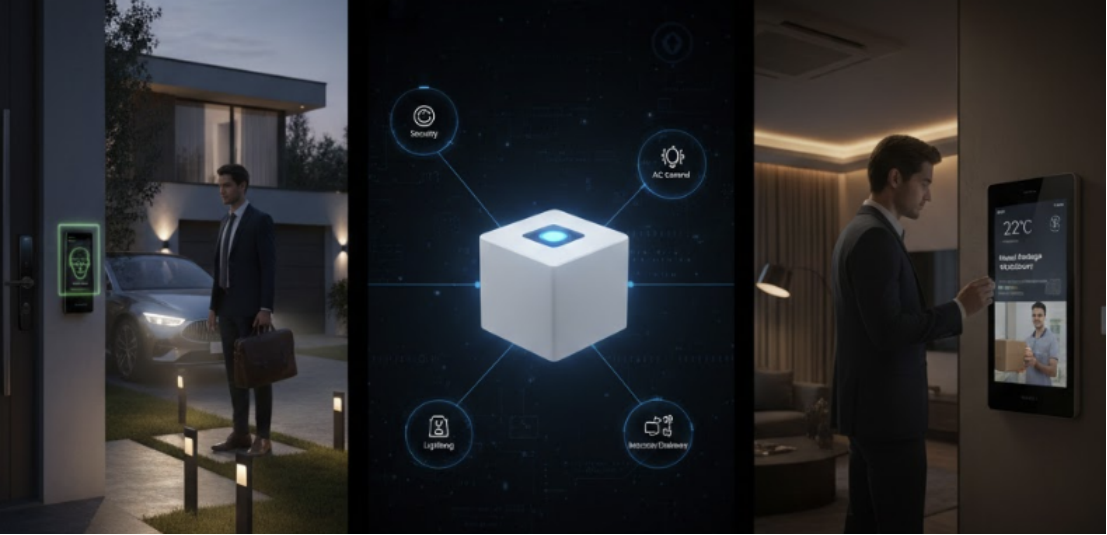
Xiamen, Fujian Apr 1, 2026 (Issuewire.com) - Imagine arriving home after a long day. As your car pulls into the driveway, the outdoor lights flicker on, the smart lock disengages via facial recognition, and the hallway temperature adjusts to your preferred setting. Inside, your intercom screen displays a missed delivery notification from the afternoon, complete with a video snapshot of the courier. This seamless orchestration is not a futuristic fantasy but the daily reality of a home powered by a High Quality Smart Hub Service. At its core, the smart hub acts as the brain of the household, bridging the gap between security, communication, and comfort. For the user, the benefits are profound: enhanced peace of mind through real-time monitoring, significant energy savings via automated climate control, and the sheer convenience of managing an entire "smart community" lifestyle from a single, intuitive interface. By centralizing disparate devices into one cohesive network, a professional smart hub service transforms a living space into a responsive environment that anticipates and fulfills the needs of its occupants.
Understanding the Pillars of a Professional Smart Hub Ecosystem
Selecting a reliable smart hub service requires a strategic approach that looks beyond basic hardware specifications. In a market saturated with consumer-grade plug-and-play devices, professional-grade solutions stand out through their stability and scalability. When evaluating a provider, the first consideration should be their standing within the global and regional technology landscape. For instance, companies that have shaped the industry for decadessuch as those founded in the early 1990soften possess a deeper understanding of the complexities involved in building intercoms and smart home integration.
A high-quality service provider is typically characterized by its involvement in setting industry benchmarks. LEELEN, for example, has transitioned from a specialized manufacturer to a chief editor of national smart home standards in China. This level of institutional expertise ensures that the smart hub is not just a standalone product but a component of a larger, standardized framework. When a provider leads international and national drafting groups for building intercoms, it signals a commitment to compatibility and long-term reliability that smaller, generic brands cannot match.
Key Criteria for Evaluating Smart Hub Providers
To secure a smart hub service that offers genuine value, buyers should focus on several critical dimensions of enterprise competence and technical innovation:
The sophistication of a smart hub is directly proportional to the research and development invested in it. A professional provider must integrate R&D, manufacturing, and sales within a controlled ecosystem. Large-scale operations, such as industrial campuses spanning hundreds of thousands of square meters, allow for rigorous quality control and the capacity to innovate at scale. This infrastructure supports the production of devices that can handle the high-traffic demands of smart communities, moving beyond simple individual home use to complex multi-unit management.
Statistical evidence of market share is a strong indicator of service reliability. A provider that serves tens of millions of users and maintains a significant percentage of a major national market demonstrates that their technology has been stress-tested in diverse, real-world environments. This volume of usage generates the data necessary to refine software interfaces and hardware durability, ensuring that the smart hub remains responsive over years of continuous operation.
A superior smart hub must act as a bridge between different protocols. The core competitiveness of a provider often lies in its ability to offer integrated solutions for both smart homes and smart communities. This means the hub should seamlessly link building intercoms with internal home automation. Innovation in this space involves creating "all-in-one" devices that reduce clutter while increasing functionality, such as hubs that double as security monitors and communication portals.
For international buyers, adherence to global standards is non-negotiable. Certifications such as the CE mark indicate that the smart hub meets essential health, safety, and environmental protection standards. These credentials are vital for ensuring that the electronics are safe for residential installation and compatible with international electrical infrastructures.
The Importance of a Robust Service Network
Beyond the physical hub, the "service" aspect of the procurement is paramount. A smart system is only as good as the support behind it. Professional providers distinguish themselves by establishing extensive networks of branch offices and service stations. This localized presence ensures that technical assistance, software updates, and hardware maintenance are readily available. In the context of large-scale property developments, having access to hundreds of service stations ensures that any system-wide issues can be addressed promptly, minimizing downtime for residents and maintaining the integrity of the smart community.
Future Horizons: The Convergence of AI and Smart Infrastructure
The smart home industry is currently entering a phase of rapid transformation, moving away from reactive systems toward proactive, AI-driven environments. The future of smart hub services lies in their ability to analyze user patterns and automate environment adjustments without manual input. We are seeing a shift where the hub becomes an invisible assistant, managing energy efficiency based on real-time utility rates and occupancy sensors.
Furthermore, the trend is moving toward the "Smart Community" concept, where individual smart homes are linked to broader neighborhood services, such as smart parking, communal security, and property management portals. Companies that have a dual focus on both the individual residence and the macro-building infrastructure are uniquely positioned to lead this change. As international standards continue to harmonize, the emphasis will remain on security, data privacy, and the seamless interoperability of Internet of Things (IoT) devices.
In conclusion, sourcing a high-quality smart hub service is an investment in the long-term viability of a property. By prioritizing providers with a deep historical foundation, a leadership role in standard-setting, and a massive, proven user base, buyers can ensure they are adopting technology that is both cutting-edge and dependable.
For more information on integrated smart home solutions and professional smart hub services, please visit: https://www.smartleelen.com/
Source :Xiamen Leelen Technology Co., Ltd.
This article was originally published by IssueWire. Read the original article here.
